The Spaces Don’t Lie
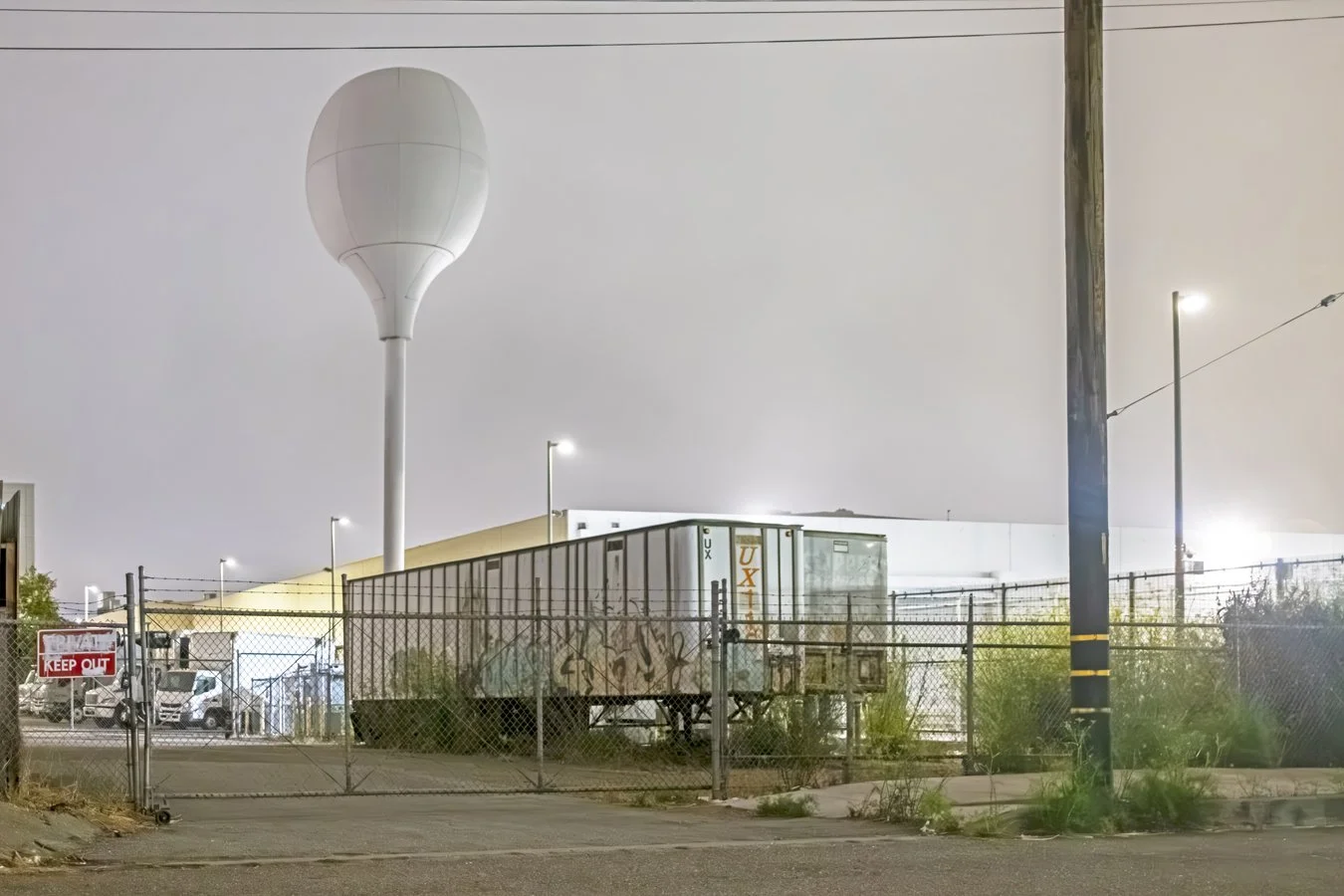
Orb Yard Night, San Francisco, 2025
"The greatest thing a human soul ever does in this world is to see something, and to tell what it saw in a plain way."
— John Ruskin, Modern Painters III (1856)
There's a category of building we rarely get to know. Not because it's hidden — it's usually right there, at the edge of the freeway, at the end of the off-ramp, along the road you take to get somewhere else. They’re made of corrugated metal, concrete, or something equally nondescript. There’s usually a loading dock, security cameras, and a chain-link perimeter, with no signage other than “no trespassing.”
These are the buildings that manufacture, store, process, repair, and distribute the goods and services that power our modern economy. They are the load-bearing buildings on the edge of town. They’re essential, nearly invisible, and indifferent to our presence.
I've been photographing them for years, sometimes as an abstract texture, or as a distressed backdrop in an environmental portrait. As I pivoted to documentary work last summer, I began a deeper exploration of San Francisco's Bayshore corridor in the Bayview-Hunters Point neighborhood. It’s a historic area that once hummed with heavy industry and now features light industry cohabitating with residential neighborhoods. The more time I spent in industrial areas in San Francisco and beyond, the more I learned about how and why we marginalize them and why they seem so anonymous.
John Ruskin — the Victorian critic and author who believed that a building is never just a building — argued that the architecture of a place is a record of its social and moral condition at a particular moment in time. In his era, industrialization was still nascent but already polluting the environment. When Ruskin wrote that the greatest human act is simply to see something and report it plainly, he was talking about painting, but he could have been speaking of documentary-style photography.
These industrial zones aren't unfriendly, ugly, or simply innocuous by accident. They reflect — with brutal honesty — what a society actually values. In effect, we ghettoized them. Industrial areas such as the Bayview, Bayshore, Oakland, and Phoenix’s Valley of the Sun (also featured in this series) were built to efficiently process, move, and contain goods and services. When those functions become unprofitable, the buildings fall into disrepair. Today’s logistics demand ever greater scale and automation — and older industrial parks must struggle to compete and reinvent themselves.
The photographs in this series are an attempt to illuminate these issues, among others. They also celebrate the unexpected beauty and sly humanity of these mostly unseen areas. We can handle the truth about them. These industrial spaces don't lie. They just don't speak unless we look at them.